Building data
systems that
stay resilient
when the real
world gets messy.
I'm Vaibhav Alluri—an engineer who orchestrates cloud infrastructure, streaming platforms, analytics, and applied machine learning to solve complex, real-world problems. I design for reliability and scalability, building coherence across every layer.
Selected Work
Systems I've Designed and Built
Infrastructure, data pipelines, analytics, and applied machine learning spanning professional, academic, and independent work.
Graduate assistantship
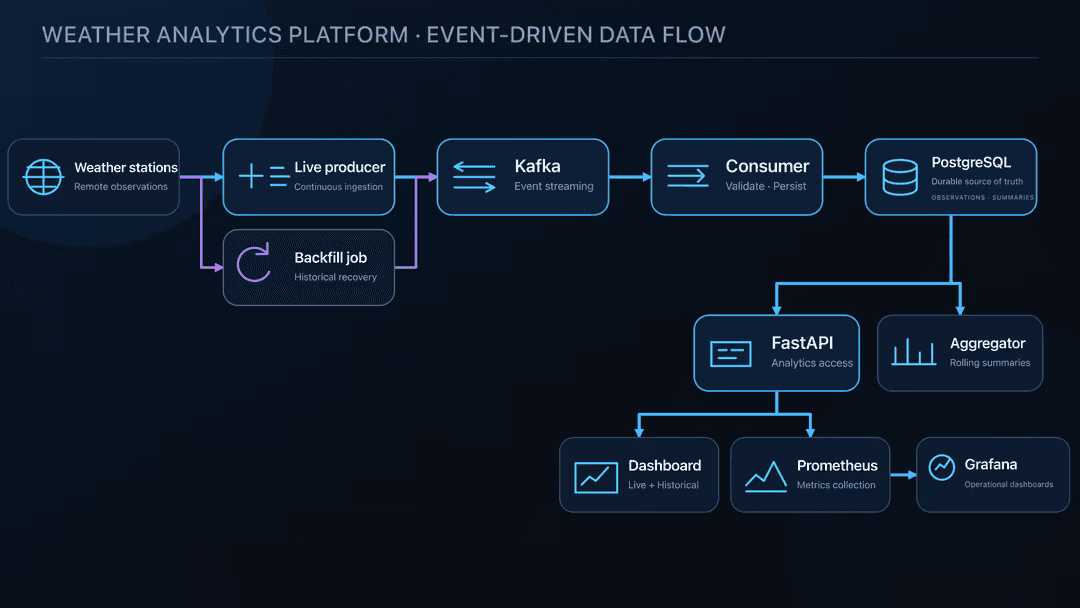
Weather Analytics Platform
A recoverable, event-driven platform built around a simple principle: infrastructure can be replaced, but durable data should persist.
5+
weather stations
7
independently managed workloads
4
pipeline timestamps reconciled
Graduate research
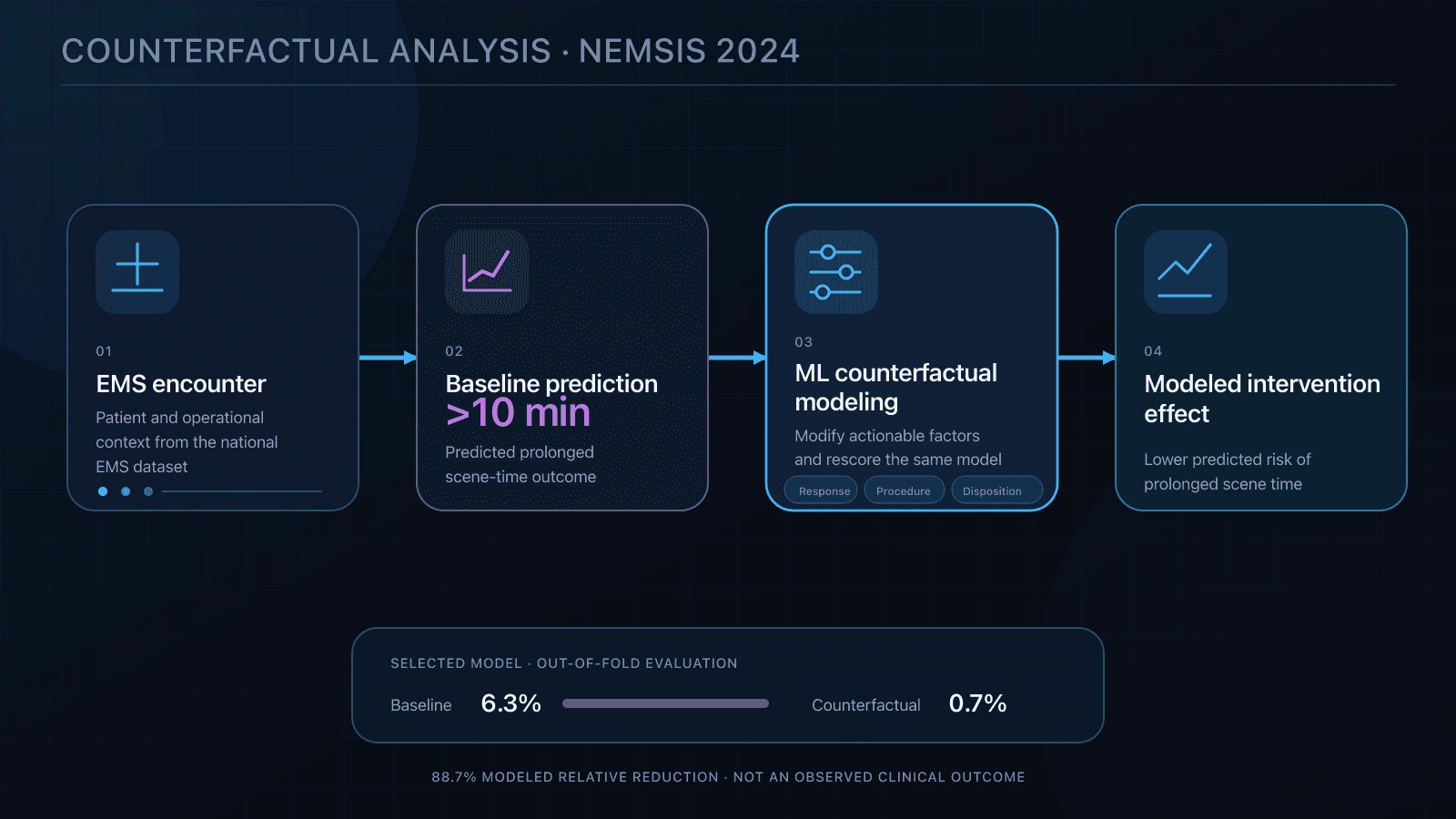
Counterfactual Intervention Analysis on EMS Stroke Response Times
A national-scale research project exploring a question beyond prediction: if selected EMS operational decisions had been different, how might the model's prediction have changed?
0.828
ROC-AUC
88.7%
modeled relative reduction
0.03%
modeled harm rate
Professional work
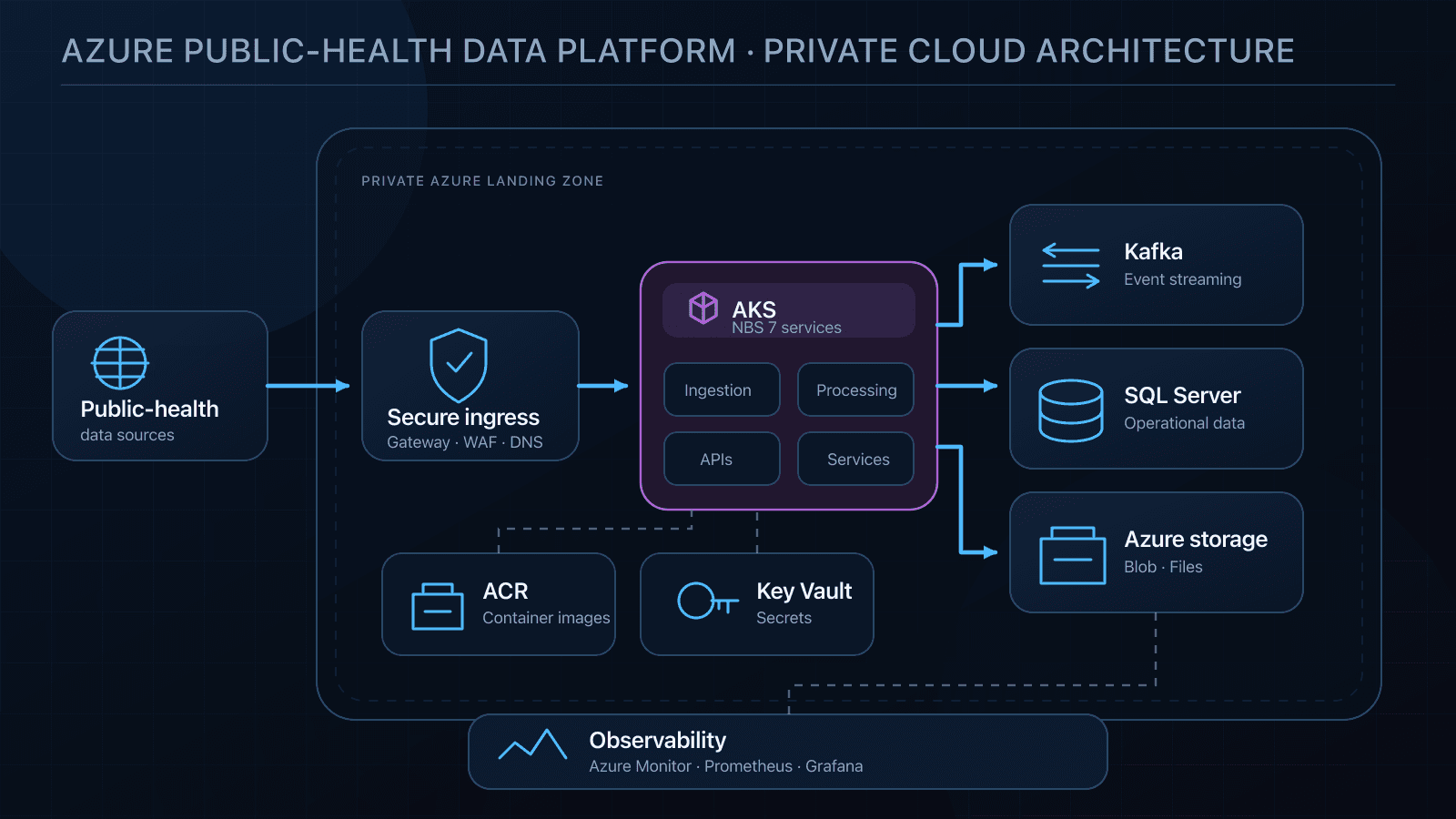
Azure Public-Health Data Platform
A secure cloud foundation designed to prove that a distributed public-health platform was ready to move from architecture into operation.
8+
integrated Azure services
IaC
repeatable provisioning
POC → PILOT
readiness progression
Independent project
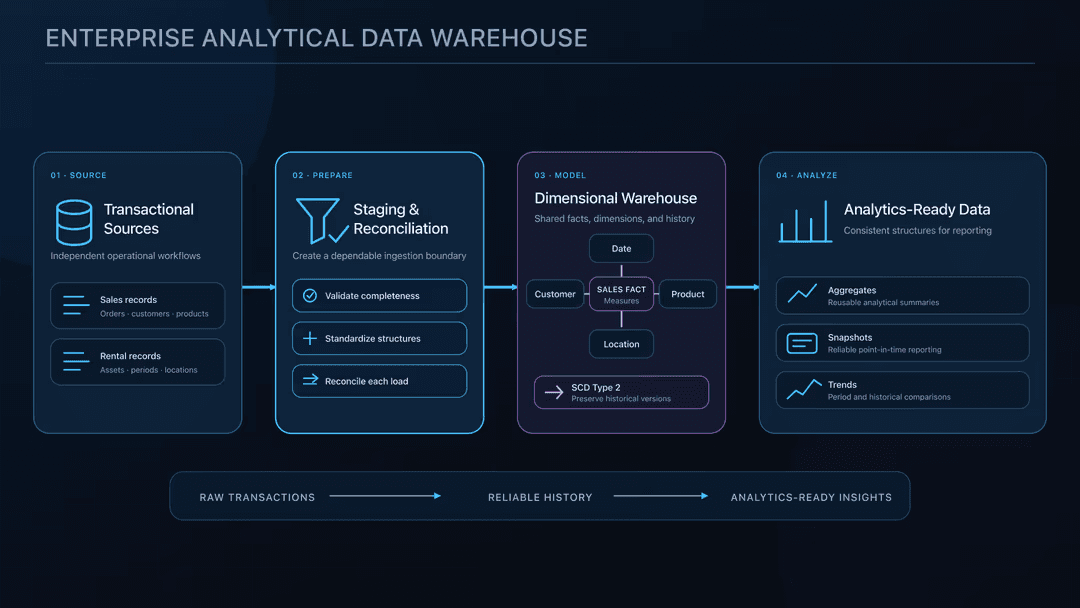
Enterprise Analytical Data Warehouse
A dimensional warehouse designed to preserve history, validate every load, and trace how business records change over time.
10K+
records per batch
8
stored procedures
6
aggregate and snapshot tables
Independent project
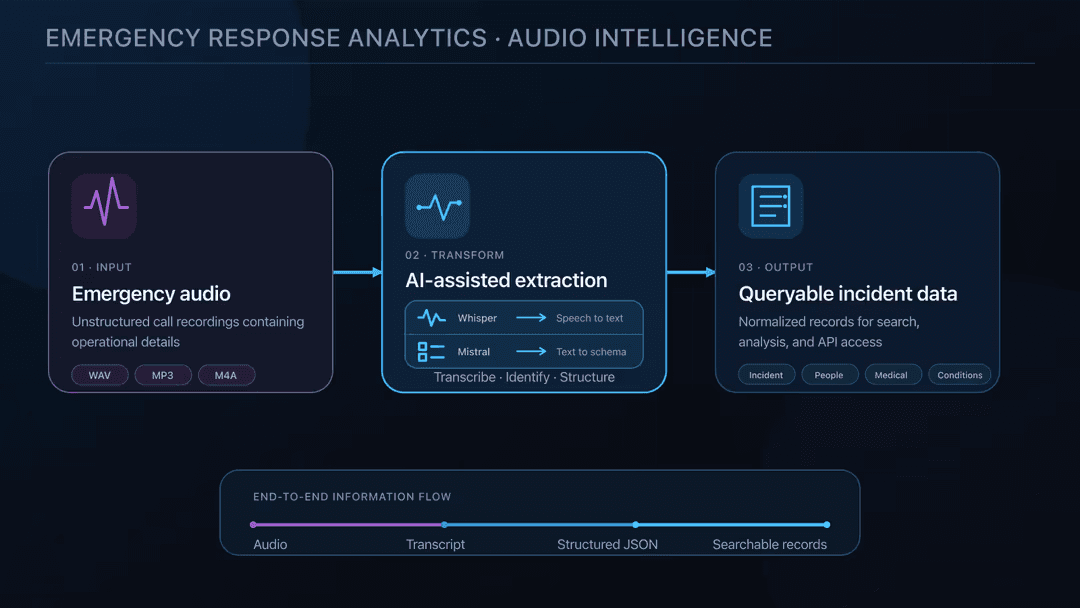
Emergency Response Analytics System
An AI-assisted pipeline that turns difficult-to-search emergency audio into structured records that can be queried and analyzed.
4
extraction categories
2
AI processing stages
E2E
audio-to-API workflow
Areas of Practice
Disciplines I Work Across
The toolkit behind the work extends across disciplines, reflecting depth in the technologies I use most often and the range to bring in complementary tools as each challenge demands.
Cloud Engineering
Provisioning and operating infrastructure that stays boring under load.
Also reach for
Data Engineering
Pipelines that move data reliably, in real time or on schedule.
Also reach for
Backend Engineering
Designing APIs and event-driven services that stay correct under concurrent, real-world load.
Also reach for
Machine Learning & AI
Applying machine learning to model outcomes and identify patterns, with AI accelerating the path from idea to implementation.
Also reach for
Professional Journey
Path So Far
Five roles, one throughline: bringing structure and reliability to data-intensive environments. From risk investigations at Amazon, to healthcare modeling and event-driven data platforms, to cloud infrastructure supporting public-health modernization.
Cloud Data Engineer
June 2026 — PresentGlobal Infrastructure Services · Richmond, Virginia
- Established a pilot-ready Azure landing zone for the CDC NBS 7 public-health modernization initiative by provisioning AKS, HDInsight Kafka, SQL Server, Blob Storage, Azure Files, Container Registry, and supporting services through reusable Terraform configurations.
- Secured communication across the distributed environment by implementing virtual networks, private endpoints, DNS, NAT, firewall controls, Application Gateway, Key Vault, and container-image delivery between ACR and Kubernetes workloads.
- Enabled operational visibility by integrating Azure Monitor, Prometheus, and Grafana, then performed end-to-end testing across AKS deployments, Kafka publish-subscribe flows, SQL connectivity, storage access, ingress routing, outbound communication, and log ingestion.
- Advanced the environment from proof of concept to pilot readiness by resolving integration gaps and delivering reusable infrastructure modules, Helm configurations, network documentation, validation results, deployment runbooks, and readiness checklists.
AzureTerraformKubernetesAKSHelmKafkaSQL ServerAzure MonitorPrometheusGrafanaGraduate Assistant — Data Engineering
August 2025 — May 2026Clarkson University · Potsdam, New York
- The department needed a reference-quality, production-style data platform demonstrating real-time and historical weather analytics, built from raw station telemetry with no tolerance for silent data loss.
- Tasked with designing and building the complete pipeline — ingestion, processing, storage, APIs, and monitoring — end to end as a solo data engineer.
- Engineered an event-driven platform using Python, Apache Kafka, PostgreSQL, Docker, and Kubernetes: built idempotent producers/consumers with offset commits gated on successful database writes, automated backfills with timestamp-based reconciliation across source, producer, consumer, and database states, REST APIs and a dashboard for live and historical trends, and Prometheus/Grafana observability across the stack.
- Delivered a fully containerized, self-healing platform that recovers only missing observations after any service or infrastructure interruption, with automated lifecycle workflows for deployment, backfill selection, and persistent storage across restarts.
PythonApache KafkaPostgreSQLDockerKubernetesFastAPIPrometheusGrafanaGraduate Research Assistant — Healthcare Data Science
October 2024 — April 2025Clarkson University · Potsdam, New York
- Investigated prolonged EMS on-scene time in stroke emergencies by analyzing the 2022 NEMSIS dataset of 51M+ nationwide activations; developed a preprocessing workflow that filtered ground-transport stroke cases, prevented target leakage, and produced a modeling cohort of 116,504 complete records.
- Addressed high dimensionality and non-normal feature distributions by applying Anderson-Darling testing, Spearman correlation analysis, near-zero-variance filtering, Chi-Square tests, and Kruskal-Wallis tests, reducing 32 candidate variables to 19 statistically relevant predictors.
- Resolved a 13.5% minority-class imbalance using ROSE synthetic sampling and an 80/20 stratified train-test split; trained and compared Logistic Regression, Decision Tree, and Random Forest models, with Random Forest achieving 70.14% accuracy, 93.65% recall, 70.25% precision, and a 0.802 F1 score.
- Evaluated model coefficients and feature importance to identify patient-handling time, total call duration, medication activity, age, response characteristics, and geographic region as key contributors to prolonged scene time, generating evidence-based findings relevant to prehospital stroke-care optimization.
PythonRSQLPostgreSQLParquetscikit-learnBusiness Analyst — Product Compliance
May 2023 — July 2024Amazon · Hyderabad, India
- Prepared and labeled training data for a product listing approval system that triaged 4,000+ daily product submissions into approve, reject, or pending decisions — enabling automation that reduced the manual review backlog by 85% within the first deployment cycle.
- Identified that the deployed system was generating incorrect rejections at scale across 4 marketplace databases, flagging a critical gap between training data quality and real-world model performance that was causing a surge in seller appeals.
- Analyzed 300+ weekly seller appeal cases to surface recurring model failure modes and SOP gaps, working directly with sellers to help them get reinstated while building a structured evidence base for proposed fixes.
- Proposed targeted changes to both the model's decision logic and the appeals process, contributing to a 19-point accuracy improvement from 46% to 65% and reducing false-positive rejection rates from 54% to 35%.
SQLExcelVBARoot-Cause AnalysisData Analyst — Risk Operations
April 2022 — April 2023Amazon · Hyderabad, India
- Audited samples of 30K+ weekly customer complaints classified by an automated keyword-based bucketing system, submitting true/false positive assessments that fed back into retraining and improving the classifier over time.
- Investigated 200+ seller, buyer, and fulfillment records weekly across 4 regional marketplace databases, tracing wrong item complaints to three root causes — inventory mismatches, seller fraud through misleading listings, and buyer abuse of the returns process.
- Developed evidence-backed enforcement recommendations including seller restrictions, bans, fraudulent buyer flags, and inventory audit triggers, and presented them to stakeholders for approval.
- Tracked complaint volumes over 6–8 weeks post-implementation to validate impact — reducing marketplace complaint rates by 45% by escalating 30+ fraudulent seller accounts and flagging 47 high-risk buyer profiles.
SQLExcelVBARisk AnalysisFraud Analysis
Writing
Engineering Notes
Short write-ups on migrations, incidents, engineering decisions, and the tradeoffs behind them—the parts not covered in the project details.

About
How I Think About This Work
What connects the different parts of my work—cloud infrastructure, streaming pipelines, healthcare modeling, marketplace risk analytics—is a habit of asking how the parts work together before asking how any one part can be optimized. A Kafka consumer that recovers cleanly after a crash, a statistical model evaluated honestly for false positives, and a fraud investigation that holds up when someone appeals it may look like different problems. The common thread is understanding the dependencies, accounting for the tradeoffs, and making each part strengthen the whole.
I came to engineering through a fairly winding path—investigating fraud and compliance cases at Amazon, then a master's in applied data science shaped by a 51-million-record healthcare study, then cloud infrastructure work on a public-health platform. Each step added a different lens to the same underlying question: how do you make infrastructure, data, analysis, and context work together as one coherent whole?
- 4.0 GPA — M.S. in Applied Data Science
- Based in New Jersey
Contact
Let's exchange ideas about reliable data systems
I'm always interested in thoughtful conversations about data platforms, cloud infrastructure, analytics, applied research, and technically meaningful collaborations. That includes full-time roles — feel free to reach out about those too.